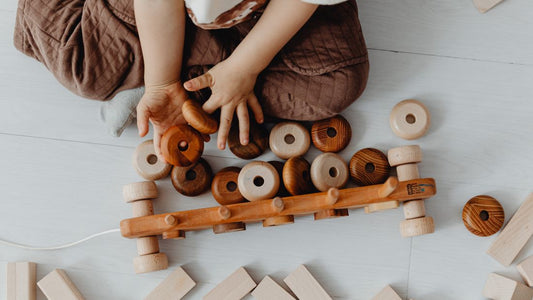

Designing Safe & Inspiring Children’s Spaces – Part 2
Designing Safe & Inspiring Children's Spaces
Part 2: Soft Play & Natural Wooden Furniture
Table of Contents
- Soft Play Equipment That Grows with Children's Imagination
- Learning Through Movement
- Soft Play That Encourages Discovery
- The Timeless Beauty of Natural Wooden Furniture
- The Wooden Rocker
- Learning Towers That Build Independence
- Wooden Stools, Chairs and Tables
- Bookshelves That Invite Curiosity
- Natural Wood Brings Calm
Soft Play Equipment That Grows with Children's Imagination

“Children do not simply play in a space. They become part of it.”
Walk into a thoughtfully designed children's play area, and something extraordinary begins to happen.
No one tells children where to go.
No one explains what to do.
They naturally move.
They crawl beneath an archway.
Balance across soft platforms.
Climb a gentle slope.
Build towers from foam blocks.
Transform tunnels into secret caves.
A simple corner becomes a magical reading hideaway.
To adults, these are beautifully crafted soft play elements.
To children, they are endless possibilities.
This is the remarkable power of open-ended play, an educational philosophy embraced by Montessori educators and child development specialists around the world. Instead of directing children toward one correct way to play, open-ended environments invite them to make decisions, solve problems, invent stories, and confidently explore their own ideas.
Unlike electronic toys that entertain for a few minutes before attention fades, thoughtfully designed soft play environments continue inspiring new adventures every single day.
A foam block that becomes a castle today may become a pirate ship tomorrow.
The same tunnel can become a train station, a cave, a mountain passage, or the entrance to an imaginary kingdom.
Nothing changes except the child’s imagination.
That is exactly how meaningful learning begins.
Learning Through Movement
For young children, movement is not separate from learning.
Movement is learning.
Before children learn to write with pencils, they strengthen the muscles in their shoulders and hands through climbing, balancing, crawling, lifting, and reaching.
Before understanding complex mathematics, they begin developing spatial awareness by moving around objects, estimating distances, stacking shapes, and recognizing patterns.
Before building confidence in the classroom, they first build confidence in their own bodies.
Every successful climb tells a child:
“I can do this.”
Every obstacle overcome quietly teaches perseverance.
Every carefully balanced step develops coordination, patience, and concentration.
These seemingly simple moments become the invisible foundation upon which future learning is built.
Soft Play That Encourages Discovery
Thoughtfully designed soft play collections are never random.
Each element serves a purpose while remaining beautifully simple.
Foam Blocks
Large foam blocks encourage children to build, arrange, experiment, and collaborate.
There is no correct answer.
Only creativity.
Some children construct towers.
Others create bridges.
Many simply enjoy discovering how different shapes fit together.
Without realizing it, they are developing early engineering skills, problem-solving abilities, and spatial reasoning.
Gentle Slides
Slides offer far more than excitement.
They help children understand balance, body awareness, gravity, and movement.
Climbing upward develops strength.
Sliding downward builds confidence.
Repeating the process encourages persistence while strengthening gross motor development.
Climbing Elements
Every climb begins with uncertainty.
One hand reaches forward.
One foot searches for stability.
Then comes the next step.
Climbing develops far more than muscles.
It teaches determination.
Patience.
Decision-making.
Confidence.
Children begin trusting both themselves and their surroundings.
Soft Tunnels
For many children, tunnels become places of adventure.
Some imagine secret passages.
Others transform them into animal dens or magical caves.
Crawling naturally develops bilateral coordination, upper-body strength, balance, and spatial awareness while adding an exciting element of exploration.
The beauty lies in its simplicity.
Obstacle Courses
Obstacle courses encourage children to combine multiple movements into one exciting journey.
Climb.
Balance.
Jump.
Crawl.
Turn.
Repeat.
Every sequence strengthens coordination while introducing problem-solving through physical movement.
No two adventures are ever identical.
Cozy Reading Corners
Perhaps the quietest space is often the most powerful.
A comfortable reading corner surrounded by soft seating, natural materials, and warm lighting invites children to pause.
To wonder.
To imagine.
Books become adventures.
Stories become memories.
Children who feel comfortable in their environment often develop a lifelong love of reading because the experience itself feels welcoming.
Learning should never feel forced.
It should feel inviting.
Safe Spaces Create Confident Children
Parents often ask what children need most.
The answer is surprisingly simple.
They need environments that encourage exploration without unnecessary fear.
Premium high-density foam.
Smooth rounded shapes.
Carefully finished surfaces.
Easy-to-clean premium PU leather.
Thoughtfully designed proportions.
Together, these details create spaces where children are free to move naturally while parents, teachers, and caregivers enjoy greater peace of mind.
Beautiful design is only meaningful when it supports safety.
Safety allows curiosity to flourish.
Curiosity inspires imagination.
Imagination becomes lifelong learning.

The Timeless Beauty of Natural Wooden Furniture
“Some materials never go out of style because nature perfected them long before we did”
There is a quiet elegance found only in natural wood.
Unlike bright plastics that gradually fade with time, wood develops character.
Its grain tells a story.
Its texture invites touch.
Its warmth creates calm.
For generations, beautifully crafted wooden furniture has remained part of childhood memories—not because it follows trends, but because it feels timeless.
This philosophy sits at the heart of Montessori education.
Rather than overwhelming children with unnecessary stimulation, Montessori environments celebrate simplicity, beauty, order, and independence.
Every piece of furniture exists for a reason.
Nothing is decorative without purpose.
Nothing distracts from learning.
Natural materials help children feel connected to their surroundings while encouraging concentration and peaceful exploration.
The Wooden Rocker
At first glance, a wooden rocker appears beautifully simple.
Yet it may be one of the most versatile pieces in a child’s environment.
One moment it becomes a balance board.
The next, a bridge.
Then a boat.
A mountain.
A reading nook.
A tiny stage.
A quiet place to rest.
Children rarely use it the same way twice.
Its curved design naturally encourages balance, coordination, body awareness, and creative thinking while supporting countless forms of open-ended play.
As children grow, the rocker grows with them, continuously adapting to new ideas rather than becoming another forgotten toy.
True design creates possibilities.
Not limitations.
Learning Towers That Build Independence
Few moments make parents prouder than hearing:
“I can do it myself.”
Learning towers gently make those moments possible.
Whether helping prepare breakfast, washing hands, baking cookies, painting, or participating in family activities, children safely reach everyday surfaces while remaining actively involved.
Instead of watching life happen around them, they become participants.
Confidence grows one small success at a time.
Wooden Stools, Chairs and Tables
Sometimes the simplest furniture creates the greatest independence.
A carefully designed stool helps children reach bookshelves.
Washbasins.
Art tables.
Learning stations.
Small wooden chairs and tables provide comfortable spaces perfectly scaled to children’s bodies.
Everything feels within reach.
Nothing feels overwhelming.
Children naturally begin taking ownership of their own environment because it has been designed for them—not merely adapted from adult spaces.
Bookshelves That Invite Curiosity
Books should never be hidden away.
Forward-facing bookshelves encourage children to make their own choices.
One story leads to another.
Curiosity becomes routine.
Reading transforms from an activity into a daily habit.
Beautiful learning environments always make discovery feel effortless.
Natural Wood Brings Calm
Modern research continues to highlight the psychological benefits of natural materials within educational environments.
Wood introduces warmth.
Texture.
Comfort.
Visual balance.
It softens busy classrooms while creating welcoming spaces where children naturally slow down, concentrate, and explore with confidence.
Timeless design is never loud.
It quietly supports everything happening around it.
العلامات:
سابق
Designing Safe & Inspiring Children's Spaces
التالي
Safe Children’s Spaces: Furniture, Soft Play & Learning
Related articles

Back to School and Beyond: Choosing the Perfect Laptop Bag for Every Journey
Post Date:
Aug 28, 2025