

Why Do Two Office Chairs Look the Same but Have Different Prices?
📋 Table of Contents
FATIO Insight A quality office chair isn't judged by how it looks on the day it's delivered. It's judged by how it performs after thousands of hours of everyday use.
Why This Question Matters
After helping businesses across the UAE furnish offices for years, one question has remained remarkably consistent.
The Question We Hear Every Week "These two office chairs look almost identical. Why is one significantly more expensive?"
It's a sensible question, and one every buyer should ask. Whether you're purchasing a single office chair for your home office or several hundred for a corporate project, comparing products by appearance alone rarely tells the full story.
In our experience, the real differences only become obvious after months, or even years, of everyday use. Some chairs continue supporting employees comfortably throughout the working day. Others begin to lose their shape, develop movement in the frame, or simply don't perform as expected. The reason is usually hidden beneath the upholstery.
An office chair is not just a seat with wheels. It's an engineered product made from dozens of components working together. The quality of those components determines how the chair performs long after it leaves the showroom.
That's why experienced procurement managers rarely begin by asking, "Which chair is the cheapest?" Instead, they ask, "What am I actually buying?"
This guide answers that question. We'll explain the same factors we discuss with architects, contractors, office managers, HR teams and business owners every week, helping you compare office chairs based on engineering, comfort and long-term value rather than appearance alone.
What You'll Learn
In This Guide
- Why visually similar office chairs can have very different prices.
- How foam quality affects everyday comfort.
- Why seat width and seat depth matter more than many buyers realise.
- Which hidden components influence durability.
- What experienced office furniture consultants compare before recommending a chair.
- How businesses can evaluate long-term value instead of focusing only on the purchase price.
1. Why Do Two Office Chairs That Look the Same Have Different Prices?
This is where many buying decisions begin. Imagine comparing two mesh office chairs online. Both have similar dimensions. Both include adjustable armrests. Both appear modern and ergonomic.
One costs AED 350. The other costs AED 850.
At first glance, paying more may seem unnecessary. However, office chairs should never be compared by appearance alone. Just as two cars may look similar while using completely different engines, safety systems and suspension, two office chairs can share a similar design while being engineered very differently. The visible design is only one part of the product.
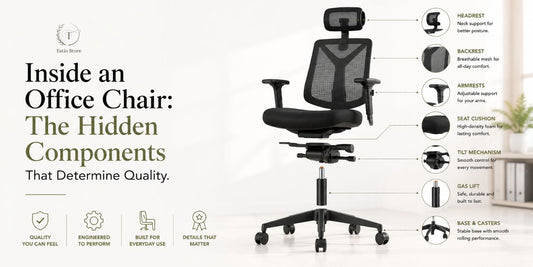
Hidden beneath the seat are components that directly influence comfort, durability and long-term reliability, including:
- Seat foam
- Internal steel structure
- Reclining mechanism
- Gas lift
- Chair base
- Engineering plastics
- Castor wheels
These components rarely appear in product photographs, yet they have the greatest influence on how a chair performs after years of commercial use.
Customer Question Should I always buy the more expensive chair? Not necessarily. A higher price doesn't automatically mean better quality. Likewise, a lower price doesn't automatically mean poor quality. The goal isn't to buy the most expensive chair. The goal is to understand what you're paying for and whether those features match the way the chair will actually be used. For example, a meeting room chair used occasionally has different requirements from a workstation chair supporting an employee for eight hours every day. Choosing the right chair always starts with understanding the application.
2. Does Foam Quality Really Matter?

If there's one component customers almost never ask about, it's the seat foam. Ironically, it's also one of the first components people notice after months of everyday use.
When a chair is new, most seats feel comfortable. The real difference appears over time. As employees sit, stand and move throughout the day, the foam is repeatedly compressed. Higher-quality commercial foam is generally designed to retain its shape and provide consistent support over extended periods of use. Lower-quality foam may lose resilience more quickly, causing the seat to feel flatter and less supportive.
This doesn't happen overnight. It happens gradually, until employees begin saying, "This chair used to be much more comfortable."
Why Foam Matters
Quality foam contributes to:
- Better weight distribution
- More consistent seating comfort
- Improved shape retention
- Greater support during longer working hours
For businesses purchasing dozens or hundreds of chairs, these differences become increasingly important because every employee experiences the same seating system every day.
Customer Question How can I compare foam quality before buying? Rather than simply pressing the seat with your hand, ask your supplier:
- Is this chair intended for commercial office use?
- Is the seat designed to maintain support throughout long working days?
- Can I test the chair before placing a larger order?
FATIO Insight In our showroom, we always encourage customers to sit in the chair rather than judge it by appearance alone. A few minutes of sitting often reveals differences that specifications and photographs cannot.
3. Why Seat Width and Seat Depth Matter More Than Most Buyers Think
When people talk about ergonomic office chairs, they usually focus on the backrest. In reality, the seat plays an equally important role. Even an excellent backrest cannot compensate for a seat that doesn't properly support the user.
Seat Width
Seat width influences:
- Freedom of movement
- Weight distribution
- Everyday comfort
- Suitability for different body types
This becomes especially important in workplaces where multiple employees use similar chairs. A seat that suits only one body type may not provide the same comfort for everyone.
Seat Depth
Seat depth is just as important. A seat that is too short provides less thigh support. A seat that is too deep may create unnecessary pressure behind the knees. The goal is to allow users to sit comfortably while keeping their feet flat on the floor and maintaining a small gap between the seat edge and the back of the knees.
Some ergonomic office chairs also include adjustable seat depth, allowing the chair to suit a wider range of users.
Customer Question Can two chairs with the same backrest feel completely different? Absolutely. We've seen customers choose one chair over another within minutes, not because the backrest was different, but because the seat dimensions suited their body better. That's why we always recommend sitting in a chair before making a decision, particularly when purchasing furniture for an entire team.
What's Next?
Coming Up So far, we've explored the parts of an office chair that directly influence everyday comfort. In the next section, we'll look deeper inside the chair—examining the mechanism, structural engineering, gas lift and chair base to understand why these hidden components often determine whether a chair performs reliably for years or needs replacing much sooner.
Tags:
Previous
Why Spare Parts Matter Before You Buy an Office Chair — The Smart Buyer's Guide to Long-Term Value for UAE Businesses
Next
Inside an Office Chair: The Hidden Components That Determine Quality
Related articles

The Silent Profit Killer: Why Elite UAE Firms are Pivoting to Performance Infrastructure
Post Date:
Mar 25, 2026

Office Chairs: Comfort and Back Support – A Comprehensive Guide to Choosing the Best Types
Post Date:
Dec 12, 2024