
THE BEST CHILDHOOD MEMORIES USUALLY DON'T BEGIN WITH A SCREEN
Sometimes they begin with a piece of wood, a little colour, and someone who chose to sit beside us.
For this first Little Humans story:
IN THIS STORY:
Table of Contents
02 Why Creating Feels Different
03 You Don't Have to Be the Perfect Parent
04 Choose Toys That Leave Something Unfinished
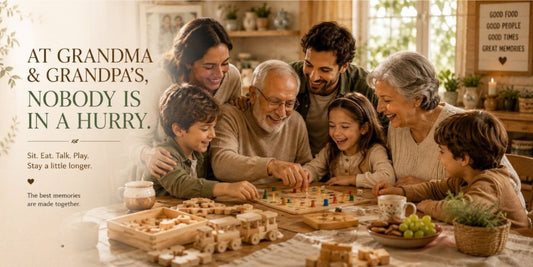
06 When Grandparents Join the Table
Ask an adult about one of their happiest childhood memories.
They may not remember what was on television that afternoon. They may not even remember the expensive toy they once desperately wanted.
But they often remember who was there.
I remember colouring with my father.
Before the colouring, we would build things from whatever we could find. An empty egg carton could become something entirely different. A simple piece of wood could become the beginning of an idea.
Nothing was perfect. There were no instructions telling us exactly how the finished creation should look.
We simply built, coloured, imagined and talked.
Years later, I don't really remember whether what we made was beautiful.
I remember my father sitting beside me.
And perhaps that is one of the quiet truths of childhood:

the feeling of making something beside someone you love.
Choosing a colour together.
Holding one piece while little hands try to attach another.
Trying something that doesn't work.
“Shall we try again?”
Laughing because the paint somehow ended up on a nose instead of the wooden robot.
Running to Grandma:
“Look what we made!”
To an adult, these can seem like ordinary moments.
To a child, they can become childhood.
Children don't only need entertainment.

Can we make the bicycle different from the picture?
What should we call our robot?
Suddenly, children are no longer simply receiving an experience.
They are part of creating it.
Play supports children's cognitive, social, emotional and language development, while warm back-and-forth interaction with caring adults plays an important role in early development.
But parents don't need to turn every afternoon into a developmental exercise.
Sometimes, the most valuable thing you can do is much simpler:
Sit beside them and make something together.
You don't have to be the perfect parent
Parents today hear endless advice.
More reading.
Less screen time.
More educational activities.
More outdoor play.
More creativity.
More quality time.
Parenting can start to feel like another thing we're supposed to perform perfectly.
It doesn't have to.
Your child doesn't need every afternoon planned.
You don't need a beautiful craft room.
You don't need to understand engineering before building a wooden helicopter.
And the finished creation certainly doesn't have to look like the photograph.
Sometimes twenty minutes is enough.
Put the phone away.
Sit down.
Open the pieces.
And ask:
“What shall we make?”
There is something precious hidden inside that simple question:
your attention.
Choose toys that leave some of the story unfinished.
This idea is particularly close to us at FATIO.
Those memories of making things from egg cartons, cardboard and simple pieces of wood made us wonder:
How can we make experiences like these easier for today's families in Dubai?
Not by replacing imagination.
By giving imagination a place to begin.
That's why we love simple wooden STEAM activities that parents and children can build together.
A few wooden pieces gradually become a bicycle, boat, helicopter, robot or another little creation.
First comes building.
Then comes perhaps the most personal part:
Making it yours.
Paint the boat green.
Give the robot yellow arms.
Make the helicopter pink.
Write your child's name underneath.
Let Dad choose one colour and the child immediately disagree.
Let Grandma help with a difficult piece.
Let Grandpa explain how he would build it, and let the child decide to do it completely differently.
There is no need for one perfect result.
Because the real objective was never simply:
“Finish the toy.”
It was:
“We made this together.”
Learning can happen without making childhood feel like school
STEAM: science, technology, engineering, arts and mathematics, can introduce children to construction, design, experimentation and problem-solving through hands-on play.
A child trying to understand why two pieces don't fit is already thinking.
Choosing how something should look involves creativity.
Starting again after something falls apart teaches something too.
But we don't believe every childhood activity needs to be measured by the skill it develops.
Children are not projects.
Sometimes building a wooden boat matters because a child discovers how things fit together.
Sometimes it matters because a father and daughter spent half an hour laughing while trying to work it out.
Both are valuable.
And grandparents belong at the table too
Creative play has no age limit.
A grandparent may not understand the newest children's game, and a child may know very little about how their grandparents once played.
But put a few wooden pieces, brushes and colours between them and suddenly they have common ground.
“When I was your age, we used to make our own toys…”
And another kind of learning begins.
A story is told.
A memory passes from one generation to another.
Grandpa helps build the wheels.
Grandma chooses a colour.
The child paints everything purple anyway.
Perfect.
Because the little wooden creation is no longer just a toy.
It carries a piece of the family with it.
Creating more screen-free moments doesn't require banning screens
The goal isn't to make parents feel guilty about technology.
Instead, create small alternatives worth putting the screen down for.
Build with wooden pieces, blocks, recycled materials or even the cardboard box from yesterday's delivery.
Let children colour what they make without correcting their unusual choices.
Ask “What do you think?” before showing them the answer.
Invite grandparents or siblings to join.
And when it's finished, don't worry about whether it looks perfect.
Write your child's name and the date underneath.
Put it somewhere they can see it.
One day, that imperfect little robot may become surprisingly valuable.
Not financially.
Emotionally.
Childhood moves faster than we think.
There will eventually be a last afternoon when your child asks you to sit on the floor and build something.
You probably won't know it's the last one.
A last badly painted wooden boat.
A last little hand asking for help with a difficult piece.
A last:
“Mummy, look!”
A last:
“Daddy, help me.”
Children grow.
That's exactly what we want them to do.
But perhaps that's why ordinary moments deserve our attention while they're still ordinary.
The bicycle may eventually disappear.
The robot might lose an arm.
The colours will fade.
The cardboard box will certainly be thrown away.
But something else can remain.
The memory of who sat beside them.
At FATIO, we can bring the wooden pieces.
The bicycle. The boat. The helicopter. The robot. The colours. The beginning of an idea.
We can make it a little easier for busy families to start.
But you create the part that matters most.
Your conversation.
Your laughter.
Your child's imagination.
Your time together.
Because technology can teach children many things.
Humans teach children what being together feels like.
And years from now, when someone asks your child about one of their happiest childhood memories, perhaps they won't remember what was on the screen that afternoon.
Perhaps they'll smile and say:
“I remember when we used to make things together.”
FATIO | Little Humans
Build something. Colour something. Remember something.
Tags:
Related articles